
*****************************************************************************************************************************************************************
JANUARY 2012 UPDATE
*****************************************************************************************************************************************************************
PETE JOHNSON *****************************************************************************************************************************************************************
KEITH TRUEMAN *****************************************************************************************************************************************************************
IAN MANDERSON *****************************************************************************************************************************************************************
FEBRUARY 2012 UPDATE
*****************************************************************************************************************************************************************
GREG BROOKES *****************************************************************************************************************************************************************
KEITH TRUEMAN *****************************************************************************************************************************************************************
KIER HARDY *****************************************************************************************************************************************************************
PETE JOHNSON *****************************************************************************************************************************************************************
TREVOR HALE *****************************************************************************************************************************************************************
MARCH 2012 UPDATE
*****************************************************************************************************************************************************************
KIER HARDY *****************************************************************************************************************************************************************
TREVOR HALE *****************************************************************************************************************************************************************
PAUL JAMES *****************************************************************************************************************************************************************
PETE JOHNSON *****************************************************************************************************************************************************************
KEITH TRUEMAN *****************************************************************************************************************************************************************
APRIL 2012 UPDATE
*****************************************************************************************************************************************************************
*****************************************************************************************************************************************************************
TREVOR HALE *****************************************************************************************************************************************************************
PETE JOHNSON *****************************************************************************************************************************************************************
KIER HARDY *****************************************************************************************************************************************************************

 Since Canada Road was built (back in the early 1980s), I have often sketched concepts and collected ideas for a
follow-up project, but these had never developed until now. With the new 'Canada Road 2' baseboards finished, attention has turned
to preparing trackwork - as shown in these views.
Since Canada Road was built (back in the early 1980s), I have often sketched concepts and collected ideas for a
follow-up project, but these had never developed until now. With the new 'Canada Road 2' baseboards finished, attention has turned
to preparing trackwork - as shown in these views.

My preferred method of building turn-outs is on a purpose made piece of hardboard with the sleeper spacings
lined out in black biro. In this view an interlaced 3-way starts to take shape, beginning with the straight through rails
and crossing noses. With the nose positions established the two outside stock rails can be added, and then the remaining
rails added progressively. I set gauge using an EMGS barrel trackgauge and vernier caliper. In the critical sections the
gauge is confirmed to be correct as each solder joint is made.

A general view showing the second 3-way nearing completion. C&L Finescale sleepers and chairs have been
used with SMP rail. Although the bonded plastic C&L system is very quick and easy I prefer the strength of copper-clad
strip and solder in the complex areas, hence the mix that is shown. The rail used is a combination of nickel silver and
phosphor bronze, the latter used to suggest rusting on the less heavily used lines and check rails.

The copper cladding has been slit for electrical isolation using an abrasive disc in a minidrill. The
slits are positioned to be largely hidden behind the rail from the normal viewing side wherever possible. Slimmed down
C&L chairs (cut in half) are then bonded on top – this stage is a bit of a slog!

 The opportunity was taken to carry out some detail work on the retaining wall, using copper wire to
represent cabling.
The opportunity was taken to carry out some detail work on the retaining wall, using copper wire to
represent cabling.

Other structures such as signals and relay boxes have also be 'positioned in place', and although
the location of such items may change, it's a good idea to get a feel for the detailing aspect during these early
stages of construction.

The platform is now surfaced and the edging stones have been gently scribed in using a sharp knife blade, and then
painted using different hues of colour. The weathering of dust and grime will be applied later.

The platform is to have an awning covering it all the way along to the road bridge, and the earthen filled abutment
that is currently in place is to be dispensed with, to make way for the structure all the way up to the bridge.

The concrete hard standing is made from 3mm thick foam core card with shallow cuts into it to represent the expansion
joints. Rail and pipe fencing will more than likely be built onto a low foundation wall along the edge of this concrete apron to
contain the loading area.

 The recent appearance at the Thornbury model railway exhibition gave me the opportunity to capture
some atmospheric images within an industrial landscape. A Hudswell Clarke diesel shunter pauses between shunting
duties at The Brewery.
The recent appearance at the Thornbury model railway exhibition gave me the opportunity to capture
some atmospheric images within an industrial landscape. A Hudswell Clarke diesel shunter pauses between shunting
duties at The Brewery.

One of the benefits of a fictional setting is that locomotives associated with various regions of
the UK can be run. This view shows a Barclay 0-4-0 number D2954, lattery known as BR class 01.
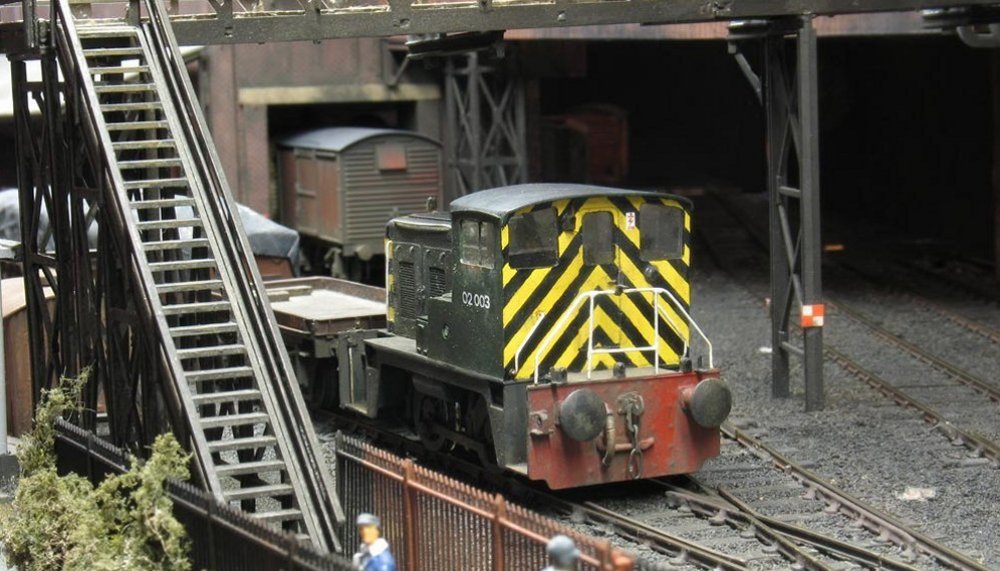
Some of the less-often seen shunters from Peter Johnson's Canada Road collection are pictured,
including this scratch-built Yorkshire Engine Co / BR class 02.

All of the locomotives featured have scratch-built bodies on either scratch or kit-built chassis,
and are powered by Portescap motor-gearbox units. Portraying the Scottish segway is BR class 06 number D2444.

The recently completed ‘Grano’ wagon in a suitable brewery setting.

 D5909 heads a special freight from East London to the West Midlands in 1970, worked by Stratford men with
a route conducter from Rugby due to traction shortage!
D5909 heads a special freight from East London to the West Midlands in 1970, worked by Stratford men with
a route conducter from Rugby due to traction shortage!

This Heljan model has been converted to EM gauge and joins the Shenston Road fleet, finished off
with weathering to a photograph of the loco C1970.


Whilst waiting for the special freight, this Alco switcher was seen at BSC Shenston Road.
 Construction of the parcels facility at Lesney Road is complete. I managed to get some good modelling
time in on Thursday (26th Jan public holiday here to celebrate ‘Australia Day’) and I even mowed the lawns as well!
Construction of the parcels facility at Lesney Road is complete. I managed to get some good modelling
time in on Thursday (26th Jan public holiday here to celebrate ‘Australia Day’) and I even mowed the lawns as well!

The brief for this model structure was to create a blend of designs that I have seen both railway, and
commercially. The use of mixing brick and timber mediums was adopted for greater visual interest. Another factor was
that it would not shout any particular BR region, although the M.R. styled signal box windows from Ratio, could I suppose,
undermine this to some extent.

Showing the building in situ' during construction - Lesney Park though is a imaginary scenario on the
BR system, and for me it will provide a platform on which to separately enjoy locomotives and stock from different regions.

The model is scratch built entirely from plastic making use of Evergreen strips and sheet styrene, the
latter appropriately overlaid with brick sheet by Slaters.

The double entry doors are from a Wills pack, whilst the roller shutter doors are improvised using
pressed corrugated aluminium sheeting. Rain water guttering and down pipes are a mix of Wills, Ratio, and Evergreen styrene rod.

Humbrol Enamel paints were brushed by hand on the building structure, while the roof was airbrushed, and
with three shades of grey applied for effect.

For the mortar lines on the brick faces, I have used Vajello - Game Colour - bone white acrylic paint.
This was diluted with water and flowed into the crevices. The development of skills in this area, and the
knack of finding perfect environmental conditions to make this process smoother is still under development.

 I came across this American HO scale building kit by 'City Classics' (Smallman Street Warehouse) at a
recent swapmeet, to fill a parcel of land beyond the railway. It will be located behind the viaduct with the lower
storey hidden from view.
I came across this American HO scale building kit by 'City Classics' (Smallman Street Warehouse) at a
recent swapmeet, to fill a parcel of land beyond the railway. It will be located behind the viaduct with the lower
storey hidden from view.

Although there is still some further detailing to be carried out, and it makes up into a good
representation of a manufacturing plant in the industrial area.

As I was passing Hornsey Road depot, I managed to take a snap of HS4000 Kestrel resting between duties. This
Heljan model has been detailed and weathered to represent it during the last year in the UK, before being exported to
the USSR in the early 1970s.
 Trackbuilding has continued with a double-slip, this time built entirely by the PCB strip and solder
method. I began this one with the two crossing noses, carefully aligned, and then added all the surrounding rails and switch blades.
Trackbuilding has continued with a double-slip, this time built entirely by the PCB strip and solder
method. I began this one with the two crossing noses, carefully aligned, and then added all the surrounding rails and switch blades.

The double-slip on Canada Road has sometimes given trouble at the switchblade solder joints. With four quite
short switchblades at each end the operating forces are high, and the solder fatigues and cracks after a few hundred operations.
In an attempt to overcome this on the new project only one of the switchblades at each end flexes, the other three being located
by sliding C&L brass fishplates soldered at one end only.

With the turnouts prepared, progress has been rapid once tracklaying began – these views show the appearance
of board 2 after just one day. The various turnouts had surplus rail length trimmed off as required to give track joints at the
correct positions. Evostik was used to bond the PCB sleepers to the painted plywood deck.

A view looking along the board towards the yard entry. The bedplate for the weighbridge is from the Cooper
Craft kit, but with all the rail clamps carefully cut off, re-spaced for EM, and then bonded back in position. PCB and solder
construction has been used at section break locations and also to reinforce the board edge track joints.

A bird’s eye view of board 2, with the original full size planning diagram for that board alongside for
comparison. The track centrelines were marked out in pencil before any pieces were positioned. The trackwork generally is
aiming to improve on Canada Road for accuracy, with more prototypical alignments, and scale rail lengths with fishplated joints.

A general view of board 3. Those familiar with Canada Road may recognise a similarity in the track
diagram……well with a fleet of shunters and a couple of hundred wagon models the new project was never going to be a
passenger-only branch line station!?

A detail view of part of board 3. A gold marker pen has been useful to mark details to be added –
‘FP’ shows where fishplates are still needed – and the reference numbers for the wiring connections.

Another detail view showing turnout number 10 (T10) and a few of the isolating sections (S14 etc).
A section of track is still to be added for S17 - the centreline marking in pencil can just be seen.

Board 1 is mostly a five road sector plate made from hardboard with aluminium angle edging. The
added area at the back of the plate will be useful for standing stock items, such as brake vans.

A detail view of the entry end of the sector plate, with a line marking where the scenic break will be just visible.

End stops for the five tracks have been made from bent rail and copper-clad strip. The power
feeds for the tracks jump onto the plate close to the pivot, where the relative movement is least.

 Having spent the latter part of 2011 building walls, house alterations and decorating, I now have
a place to resume my modelling projects, and this view shows my work bench and current projects.
Having spent the latter part of 2011 building walls, house alterations and decorating, I now have
a place to resume my modelling projects, and this view shows my work bench and current projects.

My layouts and rolling stock are based on examples which would have been seen in some of the remote parts
of the British Isles, namely the Cambrian Coast in West Wales, and the West Highlands of Scotland. Several locomotives can
be seen on the shelf awaiting final detailing.
 A Dapol class 22 has arrived at the workshops, and will feature on cross-London freight
work in the Hornsey Broadway area. Allocated to Old Oak Common, D6326 was the last London example to remain
in green livery in 1970, just before getting a fresh coat of blue for its last few months in service!
A Dapol class 22 has arrived at the workshops, and will feature on cross-London freight
work in the Hornsey Broadway area. Allocated to Old Oak Common, D6326 was the last London example to remain
in green livery in 1970, just before getting a fresh coat of blue for its last few months in service!

The chassis upturned and a start made on removing the wheelsets and
dismantling. The flanges are a little bit chunky for my liking, so they are re-profiled by taking 0.015"
off the rear face in the lathe and polishing the flange smooth.

The original wheels re-profiled and awaiting refitting. Further down the page is a conversion
by Paul James using replacement spoked wheels supplied by the EM Gauge Society.

Back in place with some Peco fibre washers making sure everything stays central. The top
edge of the bogie frame requires pairing back slightly for clearance of the EM wheelsets.

The bodyshell after treatment of intial weathering. The last 2 digits of the number have
been scraped off, as well as the silver surround to the cab door.... the far door still to do.

The cab bulkhead looked to be flat on the real thing, so rather than highlight any
innacurate features, I have gone for a more subdued look which still captures the important points.

The same method is applied to these other cab interiors from the Heljan Baby Deltics.

D6326 in a position to earn its keep now!

Going Underground - 1959 tube stock disappears into the tunnel heading for Central London.

This
tunnel module has been constructed so that internal detailing and cables can be added before fitting in place.

Constructed entirely from plasticard sheet, the tubes were rolled and formed to the right diameter
and then encapsulated within a rigid box structure. A service climbs out of the darkness and slows down for
the station.

A view looking down the tracks towards the tunnels. Track is C&L with the addition of 3rd & 4th rail
(code 60 flatbottom secured on Peco individulay insulators).

Must get around to doing the handrails on the front of the nearest car - it's been like that for
far too long, and the headlight arrangement also requires modifying. The 1959 tube stock is by EFE.
 A quiet moment at the work bench, whilst I decide which project to pick up next. It
looks like a bit of a Southern Region craving at the moment, with class 33, 73 & 74 locos awaiting attention.
A quiet moment at the work bench, whilst I decide which project to pick up next. It
looks like a bit of a Southern Region craving at the moment, with class 33, 73 & 74 locos awaiting attention.

I decided to respray the two Dapol class 22 locos, seeing as the blue paint was
already out on the Lima class 73 bodies and the DC Kits resin class 74.

Three class 33 bodies undergoing some cosmetic changes, with class 22 chassis behind
featuring freshly painted valences.

A recent diversion from locos came in the way of these Bachmann Presflos, which will form part of
a cement block train to go behind the BR(S) motive power featured above.

For an earlier period, I also fancied a rake of grey liveried Blue Circle Cement wagons. Although it's
a nice model, I think replacement buffers and some proper couplings finish it off.

Another class 22? D6331 with its freshly applied full yellow ends. The wheels were removed and
the flanges re-profiled on the lathe by a friend, before refitting and setting to EM Gauge.

I decided to fit the valences directly to the body, rather than to the chassis
as designed by Dapol, and this shows the locating lugs cut off.

A view inside the body, showing the valences fixed in place.

The Dapol class 22 next to a heavily modified Hornby cl29 showing it's age.

 Right - back to the Dapol class 22.... with another option for converting to EM Gauge. This image
shows the body removed as per ex-factory condition.
Right - back to the Dapol class 22.... with another option for converting to EM Gauge. This image
shows the body removed as per ex-factory condition.

I had some spoked wheels of the same diameter (supplied by the EMG Society a few years ago) kicking
about the wheel box. Admittedly the spoke count is different, but it doesn't make a lot of difference when they're
hiding behing the bogie frames. Shorting links had to be fitted due to the plastic centre, and the Dapol stub axles were
re-used by punching out from the original wheels. Replacement wheels to the left, originals to the right.

After receiving requests for the underframe details for the 2 centre coaches in the class 123 Inter-City
DMU, these images show the position of the various heaters, battery boxes and cubicles, etc.

Although I cannot guarantee everything is in the exact correct position, the representation is as close
as I can get with the drawings and photographs available.
 Buffer stops have now been added to the Board 3 sidings using BR-pattern bent-rail items kindly donated
by long-time Canada Road operator Tony Wood.
Buffer stops have now been added to the Board 3 sidings using BR-pattern bent-rail items kindly donated
by long-time Canada Road operator Tony Wood.

An aspect that was always rather lacking on Canada Road was trackwork only suitable for short wheelbase
shunting engines. Boards 4 and 5 of the new layout aim to recreate a little of this environment within a dockside setting.
Track laying on Board 3 has now been completed with the addition of a scale 2 chain (44 yard) radius curve leaving the
far end of the exchange sidings.

The curve brings the line into a dockside scene on Board 4, as shown in this general view. BR main
line diesels were typically limited to a 4 chain minimum curve, and only the short wheelbase shunting types would be
able to travel over tighter radii. Many of the 0-4-0 types built for dock work, such as the Yorkshire Engine Co Class
02, could even cope with 1 chain curves (264mm in 4mm scale) and although this would have been fun to model, it would
have been too limiting on the stock able to travel across it.

A closer view of the curved Board 4 entry track. A second curved line and turnout are being modelled
disused, as rail traffic into the docks has suffered a decline since their 19th and early 20th century heyday, causing
the link to the exchange sidings to be reduced to a single track during the 1950s.

Board 4 also has a typical dockside line-to-line crossover with 9 foot pivoting switchblades and more
tight radius curves. This trackwork is based on some still to be found at Birkenhead Docks - although it will have not
seen a train in at least 25 years. Unfortunately many such features around the country are fast disappearing under
re-development schemes, although in some places (Bristol is one example) ‘old’ working dock environments are being
preserved, with occasional rail trips on special days.

Beneath the boards the wiring is also making good progress, as shown in this view. The layout retains
traditional DC control, and has been generously equipped with isolating sections to allow multiple locos to be ‘on scene’.
Although this task seemed daunting almost 30 years on from wiring Canada Road, in truth it is just simple circuits
repeated multiple times, and with a bit of peace and quiet it proved easy enough to scheme it out.

The new layout will incorporate a few of the existing structures - such as this abandoned hut and bricked
up gateway - along with a lot of new features!
 This month I've turned my attention to the road overbridge, and have used aluminium
supports for strength and rigidity. The two middle stone supporting walls will sit directly beneath the
station building.
This month I've turned my attention to the road overbridge, and have used aluminium
supports for strength and rigidity. The two middle stone supporting walls will sit directly beneath the
station building.

Construction of the middle support structure for the road.....

...... and the brick abutments.

A pre-primed hardboard has been used for the road surface, and 1.75mm mounting card for the pavements.
The station building will be situated to the right of the buses.

The bridge support is based on a all-welded design, and sitting on a brick
base plinth with concrete capping.

I considered building one of the more interesting looking riveted iron
constructions, but for the sake of expediency, the more modern type was chosen.... the premise being
that it is a 1960s replacement support.
 Class 74 E6016 is a DC Kits resin model and uses a modified Heljan Hymek chassis. The
whitemetal bogie frames will need a bit of modification to suit the changes when the class were converted to
Electro-Diesels. The 4' spoked wheels are from the Alan Gibson range, and the tanks/battery
boxes are resin parts which I've cut up into sections and added extra detail.
The roof is detailed using plasticard, with turned brass air horns from Markits. Otherwise
most everything else is standard, with nickel silver handrails and some buffer beam detail.
Class 74 E6016 is a DC Kits resin model and uses a modified Heljan Hymek chassis. The
whitemetal bogie frames will need a bit of modification to suit the changes when the class were converted to
Electro-Diesels. The 4' spoked wheels are from the Alan Gibson range, and the tanks/battery
boxes are resin parts which I've cut up into sections and added extra detail.
The roof is detailed using plasticard, with turned brass air horns from Markits. Otherwise
most everything else is standard, with nickel silver handrails and some buffer beam detail.

D6327 is the Dapol model and represents the prototype when it was sub-shedded at 85B Gloucester
(Horton Road) for the period I'm modelling. This loco was one of four that received the blue small yellow panel
livery, the others being D6300, D6303 and D6314. The wheels have had 0.015" faced off the back and the flanges
reprofiled by a friend, then pulled out on their axles to run on EM gauge. I had looked at modifying the bogies
to close the gap between them and the body, but decided it was probably a lot of unnecessary work for little
improvement, and under normal viewing conditions is hardly noticeable anyway. The pipework was replaced on the bogie
side frames to a more accurate representation, and the surplus speedo cable removed from 1 bogie. The side valances
were glued directly to the body at varying angles as mentioned last month. Buffer faces had
a file taken to them to give them a flatter appearance and the buffer beam pipework supplied with the model
was fitted, although Dapol never quite get this right. Luckily I had some spare pipes from a Heljan Hymek
that did the job. Roof detail required the boiler outlet to be modified with some plasticard and filler to
represent my chosen model, while the small outlet opposite was plated over with some plasticard, this outlet
was plated over on certain locos and more likely towards the end of their careers, so always good to find a
picture. The coolant and exhaust grilles are as they came, but it would be nice to see after-market
replacement grills become available. The other work carried out was to remove the rivet detail around the
cab window frames and add a little extra detailing on the nose.

D6331 is also a Dapol model and represents the prototype when it was also sub-shedded at
Gloucester. This loco was one of two that received the full
yellow panel whilst in green livery, the other one being D6312. Strangely D6331 has been reported as going
into store at Old Oak Common in December 1968 until it final withdrawl in 1971, but this was not the
case and the loco was very active around the Glos/Worcs area up until 1970, and finally succumbed to
withdrawal at Exeter in 1971. Detailing work carried out is much the same as D6327.

D6354 represents the prototype when it was at Gloucester, and was one of the later
builds with variations on the other two, especially around the front end, and I will hopefully
cover this at a later date.

The cabs interiors of the D63xx class 22 Dapol model seem to have bulges in the
bulkheads and I can only think they were there because of the lighting.

I decided to remove the offending bulges and rebuild the interiors with plasticard,
detail wise I have kept pretty basic as one the loco is running around, you'll hardly notice.

D6507 is a Heljan model and was allocated to Eastleigh. Very little work was carried
out on this, but I have reprofiled the curvature on the cab roof to help improve its head on appearance.
This loco has been fitted with snowploughs and BRCW worksplates.

Picture showing the readable detail on the Extreme Etchings worksplate fitted to D6507.

6546 was another Eastleigh allocated loco and has had the same work carried out as D6507.

D6553 was one of the locos that were re-allocated between Eastleigh and Hither
Green quite regularly in the early days, but it was a Eastleigh allocated loco for the period I'm modelling.
Again much the same work as D6507 and 6546, although the roof was repainted a darker grey than the almost
white colour Heljan used. Unusually the worksplates on this loco were in the same position as the blue
locos, It was normal for green examples that carried full yellow fronts, to still have the worksplates
fitted in original position, which was central and directly under the number.

6594 was a Hither Green loco and was slightly narrower to suit the Hasting gauge.
Again nothing really done to this, apart from it didn't need the cab roof profile doing like the others.

E6018 was allocated to Stewarts Lane where the class spent most of their working lives.
This is the Lima model and work carried out was to re-size the engine room windows with fillets of plasticard,
fit nickel silver handrails which have been filed flat and buffer beam detail. Again the loco is fitted with
worksplates from Extreme Etchings. Work is still needed to be done around the underframe and bogies, with
some extra detail work and lowering it on its bogies. E6018 was unusual in that it carried the experimental
livery in 1967 of full yellow cabs which wrapped around to the cab doors, I have gone for the later livery
of standard rail blue, unusually the data panel was on the bodyside of this loco and not the cabside.

E6048 still carries the livery when built at the Vulcan Foundry, which it carried until
1971. Livery is Rail Blue, with Rail White which is an off white/greyish colour and small yellow
panels. Oddly the Rail Blue used is exactly the same as applied to E6018, with same preparation, exactly
the same amount of coats and sprayed at the same time, but in the photos they look different, strange
how different colours applied to a livery can make Rail Blue seem different.

A close up shot of E6048 showing the Extreme Etchings worksplate from Shawplan
 There has been a little confusion over whether my new project is again called ‘Canada Road’….
I can reveal the name chosen is ‘Canada Street’. This suits a dockside area with ocean-going
shipping trading across the Atlantic. Web research via the wonders of google maps also suggests
‘street’ was a commonly used title in these neighbourhoods, which boomed during the Victorian
railway age. Finally it gives a nice tie-in to the previous layout, which is fitting
as some of the buildings and structures are being re-used. (The street which gives its name
runs behind the dock wall at the back of the sidings, so does not actually appear on the model).
Board 5 has now caught up with the other 4, and is shown after tracklaying. Most of the board is a
four-road traverser/fiddle yard for the dock traffic. For this a hardboard deck, with a simple wooden slot guide have
been tried, with a bit of candle wax applied to smooth the motion.
There has been a little confusion over whether my new project is again called ‘Canada Road’….
I can reveal the name chosen is ‘Canada Street’. This suits a dockside area with ocean-going
shipping trading across the Atlantic. Web research via the wonders of google maps also suggests
‘street’ was a commonly used title in these neighbourhoods, which boomed during the Victorian
railway age. Finally it gives a nice tie-in to the previous layout, which is fitting
as some of the buildings and structures are being re-used. (The street which gives its name
runs behind the dock wall at the back of the sidings, so does not actually appear on the model).
Board 5 has now caught up with the other 4, and is shown after tracklaying. Most of the board is a
four-road traverser/fiddle yard for the dock traffic. For this a hardboard deck, with a simple wooden slot guide have
been tried, with a bit of candle wax applied to smooth the motion.

Track control on the traverser is via the slide switches mounted straight into the plywood deck.
The additional switch selects control of the dockside lines, between the local controller and the main (all lines) controller.

With tracklaying virtually complete, attention has now turned to the control panel. This follows the
proven formula from Canada Road, with sub-miniature slide switches in a robust aluminium case. This is more shatter-proof
than plastic, and even if it should somehow go ‘live’ there is no more than 12 volts supplied into it. The switch arrangement
was planned using AutoCad software, and then printed full size as a painting pattern and drill-centre plot.

With the switch locations drilled and filed to shape, the track diagram was painted in gloss white enamel.
The whole panel was then over-sprayed with a coat of lacquer before the switches were fitted.

Behind the panel the switch reference codes were added in black permanent marker,
and proved very useful during wiring-up!

The completed panel - white switches with track-setting logic for the points, and red/white switches for
the isolating sections. In-line is section live, out of line is isolated. A green LED confirms the power supply for the
point motor circuits. The panel was made using switches from Maplins, and their biggest standard aluminium case - which
was just big enough. Two 25-way D-connectors are mounted on the underside.

With the panel and wiring complete, and a successful testing session (after a few initial hitches),
painting of the track has started. For this I have chosen to use Humbrol matt 98 for the sleepers, and Revell matt 84 for
the rail sides and chairs. Further weathering tones will later be added on top, but these two colours give a good base.

The next stage is completion of various scenic features before ballasting. These have been started on Board 3
- the stone retaining wall by the low-level sidings is pictured.

The buffer stops for the same sidings. These provide an end-loading facility much used during WWII for
military vehicles, and occasionally for tractor exports since.

An old dock access road for the same board takes shape, using several packs of the Wills Finecast moulding.
 I've made a start on the wiring looms and connectors using 25-way D plugs and sockets, and will need
to make up around 20 pairs for the scenic sections and control panels.
I've made a start on the wiring looms and connectors using 25-way D plugs and sockets, and will need
to make up around 20 pairs for the scenic sections and control panels.
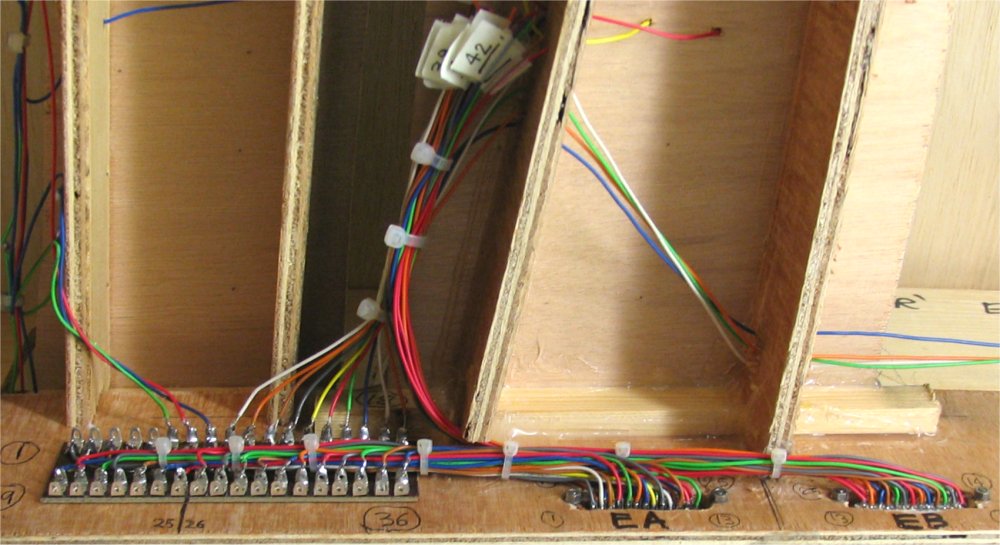
On-board wiring is taken from the plug/sockets to a solder tag board, which makes it easier for the
identification of the various circuits and access for testing. Wiring from the rail feeds and other control is all
concentrated in this area, with surplus wiring labelled for future possible use.